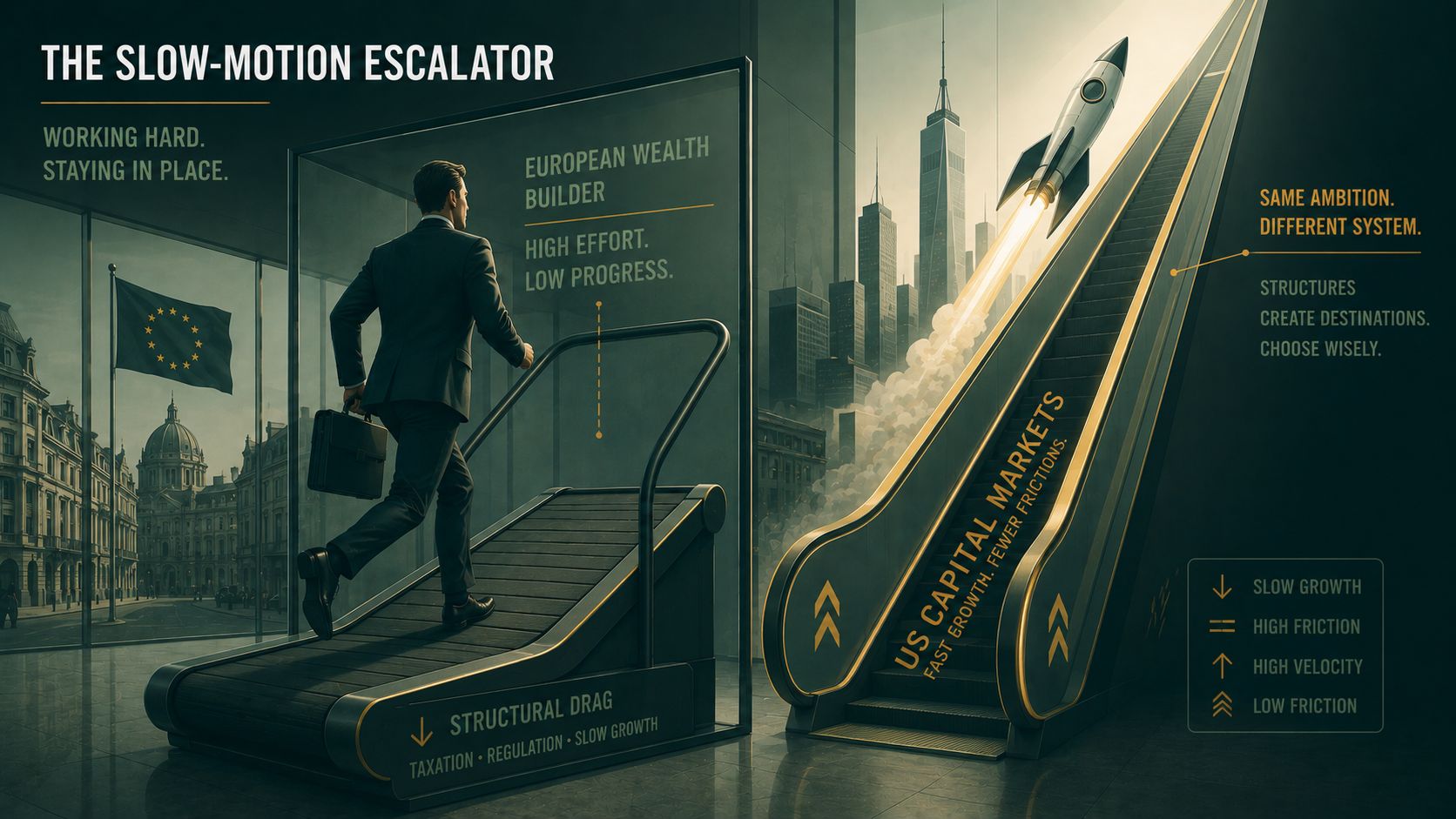
Across Europe, millions of well-paid, disciplined professionals are doing everything right.
They save. They invest conservatively. They follow whatever their bank recommends.
And their wealth still grows at a crawl.
This isn't a personal failure. It's structural.
In this article:
The four structural problems slowing down wealth building in Europe
Why "safe" investment products can quietly cost you money in real terms
The psychological cost of telling yourself "later"
What actually changes the trajectory
How to start thinking about capital differently
The European Wealth Problem Nobody Talks About
About the author

Tomas Vyšniauskas is a professional trader and founder of Sovereign Prosperity.
Trading full-time since 2021, he manages capital with a focus on disciplined growth and controlled downside.
His work is built around a simple goal: helping people make their existing capital work harder without sacrificing the freedom that wealth is supposed to create.
The traditional European wealth-building path looks like this:
Earn a salary
Pay high taxes
Save consistently
Invest conservatively through a bank or pension fund
Wait 30-40 years
That path can work. But here's the real question: at what cost?
While you're waiting, life is happening. Your best years are happening right now.
At Sovereign Prosperity, we work with ambitious professionals caught inside exactly this contradiction. Disciplined, hardworking, far from reckless - yet slowly realizing that working harder doesn't create wealth. Intelligent capital allocation does. That distinction changes everything.
Problem #1: High Taxes Quietly Kill Momentum
The benefit: Europe offers real value - healthcare, infrastructure, social systems, relative stability.
The cost: income tax, social security, VAT, capital gains taxes, corporate taxes. Combined, the drag adds up fast.
The result: a €120,000 salary in parts of Western Europe looks like real money on paper. In practice, after taxes and living costs, the capacity to aggressively build capital shrinks dramatically.
That creates a dangerous illusion. You feel successful because your gross income looks strong, but your capital accumulation tells a different story. It's why many professionals quietly feel stuck despite earning well - running, essentially, on a treadmill set on an incline.
Problem #2: Salary Ceilings Arrive Faster Than People Expect
Europe typically offers lower upside compensation than markets like the United States. There are exceptions - finance, entrepreneurship, executive leadership - but for most high-performing professionals, salary growth eventually plateaus.
Take two equally talented software engineers: one in Berlin earning €90,000, another in San Francisco earning $350,000 plus equity. The difference isn't talent. It's the amount of capital upside built into each environment. Over a decade, that gap compounds enormously.
It's part of why figures like Elon Musk and Peter Thiel built extraordinary wealth through ownership and capital exposure rather than salary. Nobody salaries their way to exceptional wealth. At some point, capital has to start working independently of labor. That's where many Europeans hit a wall.
Problem #3: Conservative Financial Products Create Slow Growth
This might be the biggest issue of all. Many Europeans keep substantial capital in:
Savings accounts
Pension products
Insurance wrappers
Mutual funds sold by banks
Conservative ETF portfolios
These products get marketed as safe. But safe is often misunderstood: low volatility isn't the same as low risk.
If your portfolio grows 4-8% annually while real purchasing power erosion runs higher than expected, you're moving backward in real terms. That's the silent danger.
As we explain in The Silent Wealth Engine, inflation isn't just the number governments publish. The deeper issue is monetary expansion and the steady dilution of purchasing power. You can end up with more euros in your account and less real wealth in your life. That's financial stagnation disguised as prudence.
This is exactly the gap between a bank's default product and an actual capital management strategy. A bank's job is to keep your money, not to grow it aggressively. Your job is to know the difference.
See how Sovereign Prosperity approaches active capital management →
A Story I Know Well
Years ago, I noticed something that changed how I thought about money: people around me were doing everything "correctly." Good jobs, responsible saving, conservative investing, long-term planning. And their financial future still felt fragile.
They weren't poor or irresponsible. They were exhausted, slowly realizing the math wasn't working. That realization became impossible to ignore. As I later put it in one of my video trainings:
"You enjoyed a pretty good lifestyle. But the way you're making money feels tiring. And the thought of continuing like this for the rest of your life drives you crazy."
That sentence resonated with many ambitious professionals because it captured something deeply familiar. They wanted a faster, smarter path to wealth - one that didn't require sacrificing the next 20 years of life.
Problem #4: Heavy Regulation Creates Hidden Friction
Europe tends to regulate aggressively. Sometimes that protects consumers. Sometimes it just creates barriers - conservative banking systems, restricted investment products, slower access to opportunity, innovation that moves cautiously.
The result: many Europeans get steered into conventional financial products that benefit institutions more than clients. That creates a system where mediocrity feels normal. And because everyone around you accepts that pace, almost no one questions it. You should.
Warren Buffett famously built wealth through intelligent capital allocation and disciplined compounding. But the lesson isn't just patience. It's owning productive capital with real asymmetric upside. Patience alone isn't enough if the underlying returns are mediocre.
The Hidden Psychological Cost
Slow wealth-building costs more than money. It creates psychological pressure - you start postponing life.
"I'll enjoy more later."
"I'll travel more later."
"I'll slow down later."
"I'll feel free later."
Later becomes the operating system. That's dangerous, because time is the one asset you can't replenish.
At Sovereign Prosperity, one principle matters deeply: wealth should serve life, not the other way around. The goal isn't just to accumulate money. It's freedom, optionality, peace of mind, a life actually lived.
So What Should You Do?
Start by thinking clearly. Most wealth problems aren't solved by earning slightly more. They're solved by improving how capital grows.
Ask yourself:
Is my capital growing fast enough to meaningfully change my life?
Are my investments truly outperforming inflation?
Am I relying too heavily on salary?
Is my strategy designed for real wealth creation, or just financial comfort?
Then focus on building a smarter financial structure.
1. Increase capital allocation intelligence. Stop blindly accepting whatever your bank recommends. Banks optimize for their own business model. You need a strategy optimized for your wealth.
2. Prioritize asymmetric opportunities. Exceptional wealth rarely comes from average-return vehicles alone. You need exposure to opportunities with real upside - responsibly managed, of course.
3. Respect risk properly. Avoid both extremes: reckless speculation and overly conservative stagnation. Professional wealth-building lives in the intelligent middle.
4. Think like an owner, not just an earner. Salary builds comfort. Capital builds freedom. That mindset shift is essential.
The Real Question
Europe offers stability. But stability alone doesn't create wealth.
Many ambitious Europeans are discovering that the conventional path is simply too slow for the life they actually want. The system wasn't built to maximize wealth creation. It was built to preserve orderly participation.
The fix isn't working harder or saving more aggressively. It's putting your capital under a strategy that's actually built to compound faster than a bank product ever will, while keeping risk in check.
That's the entire reason Sovereign Prosperity exists. We work with ambitious professionals who want to build wealth seriously - intelligently and sustainably, not emotionally or recklessly.
Explore our approach to active capital management
About the author
Tomas Vyšniauskas is a professional trader and founder of Sovereign Prosperity.
Trading full-time since 2021, he manages capital with a focus on disciplined growth and controlled downside.
His work is built around a simple goal: helping people make their existing capital work harder without sacrificing the freedom that wealth is supposed to create.
How fast is your wealth growing?
Select your current annual growth figure:
You're leaving your wealth growth to chance. You're barely outpacing inflation and you're unlikely to grow your wealth to the next meaningful milestone. You're working for the banks but not for yourself. If you'd like to fix this, download our free report - The Silent Wealth Engine - below.
You're doing something right but you're still leaving your wealth growth to chance. You're outpacing inflation but getting the leftovers that are not inspiring. You're still unlikely to grow your wealth to the next meaningful milestone. If you'd like to fix this, download our free report - The Silent Wealth Engine - below.
Congratulations, you're doing well - better than the majority of investors. You're well above the inflation rate. You're likely to grow your wealth to the next meaningful milestone. If you'd like to learn how to maintain your current trajectory in a wiser way or even grow beyond your current limits, download our free report - The Silent Wealth Engine - below.
More from Wealth Intelligence

PNC Asset Management: Insights for Serious Investors
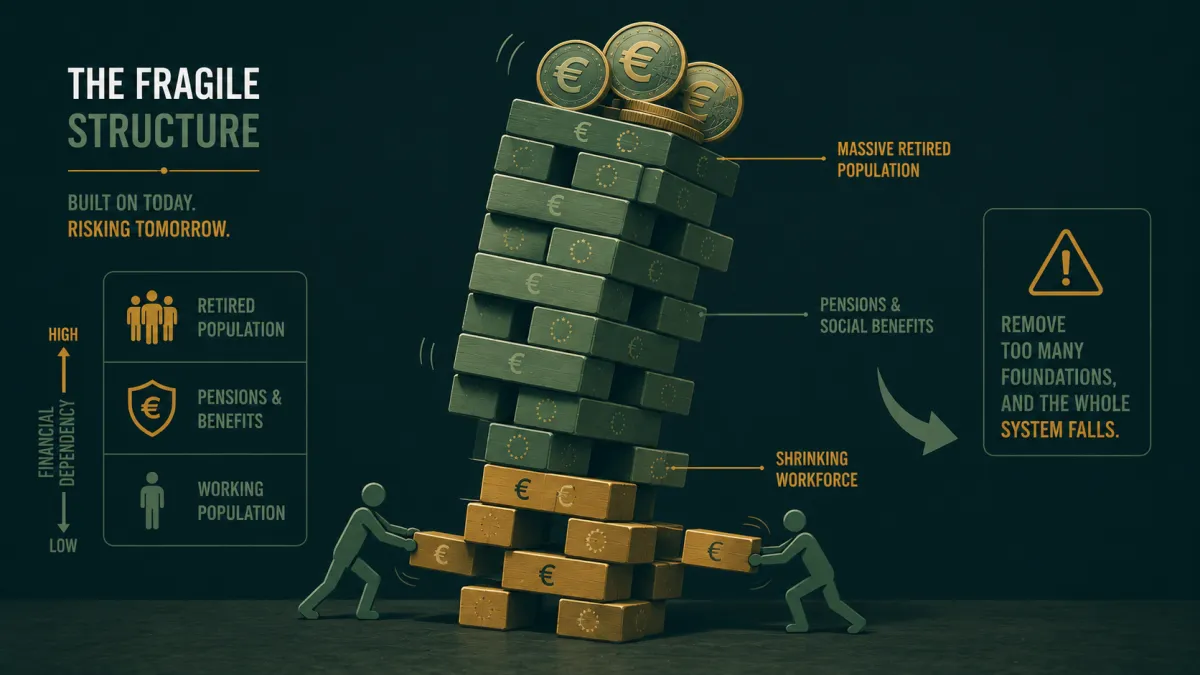
The European Pension Illusion: Why Retirement Security Is Far Less Certain Than People Think