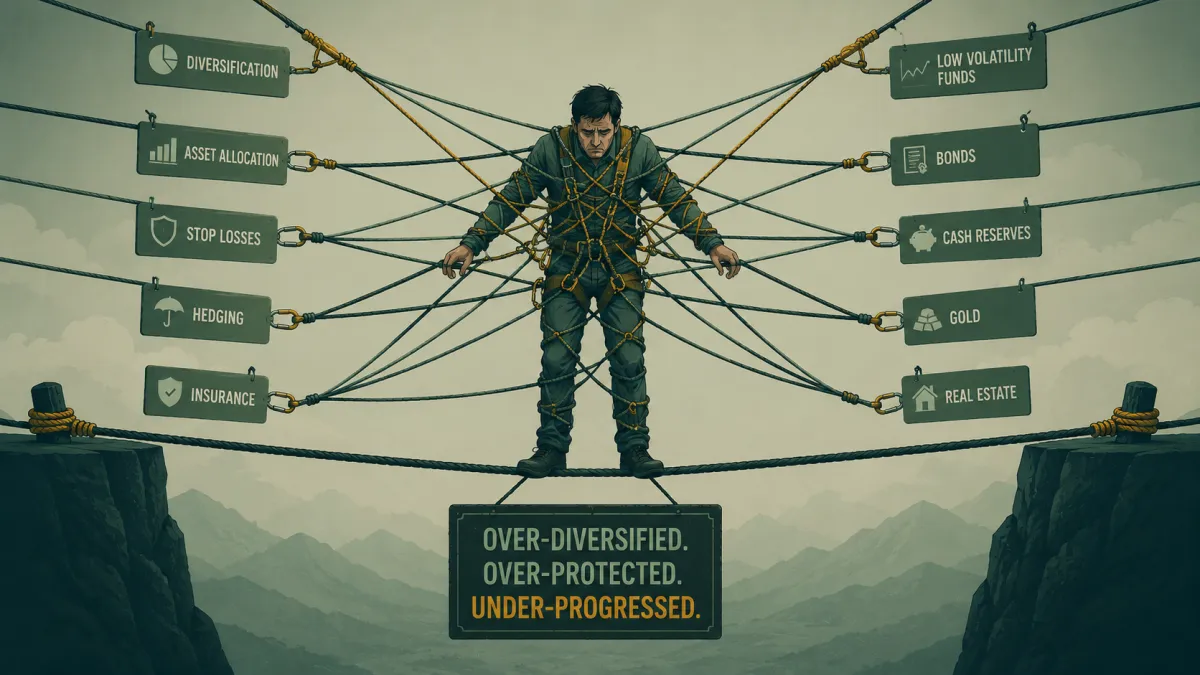
The person selling you a 40-year financial plan gets paid starting today.
You wait decades to find out if it was ever the right plan for you.
That asymmetry alone should make every serious investor stop and ask: whose interests are actually being served here?
In this article:
Why banks profit from your patience - not your performance
The hidden math behind "harmless" annual fees
A real conversation that exposed how pension funds get sold
How to separate genuine advice from incentive-driven marketing
What a wealth strategy built around your actual timeline looks like
The Business Model Hidden Behind "Long-Term Investing"
Where they make money: not when you become wealthy - while you're waiting to become wealthy.
About the author

Tomas Vyšniauskas is a professional trader and founder of Sovereign Prosperity.
Trading full-time since 2021, he manages capital with a focus on disciplined growth and controlled downside.
His work is built around a simple goal: helping people make their existing capital work harder without sacrificing the freedom that wealth is supposed to create.
How: management fees, advisory fees, fund expenses, platform fees, administrative charges. Presented as insignificant. A fraction of a percent here. One percent there.
Why it matters: wealth creation is a game of compounding. Fees compound too.
A fund charging 1-2% annually looks harmless on a monthly statement. Over 20, 30, or 40 years, that "harmless" fee can quietly consume an astonishing share of your returns.
It gets more absurd with "premium" solutions - automated robots, algorithmic portfolios, sophisticated-sounding wealth products. The pitch is always convenience:
"We'll handle everything." "You don't need to think about it." "Just set it and forget it."
It sounds attractive. But if a product charges fees for decades, the institution benefits from every extra year you stay inside the system.
The longer you wait, the more they earn.
The Marketing Genius of "Set It and Forget It"
To be fair: convenience has real value. Most people are busy building careers, raising families, running businesses, living life. Nobody wants to spend their evenings studying markets.
The actual problem: not convenience itself - convenience quietly replacing optimization.
Imagine hiring a personal trainer who tells you: "Don't worry about results. Just keep paying me for the next 40 years." You'd spot the flaw instantly.
Yet investors accept exactly this logic in finance every day.
The industry has gotten very good at selling convenience while avoiding any discussion of opportunity cost. The question isn't whether a pension fund or robo-advisor can generate some return. The real question is whether it's the best use of your capital given your goals, your timeline, and the life you actually want.
Those are very different questions.
The Conversation That Told Me Everything
Years ago, a bank consultant was genuinely surprised I wasn't using a pension fund - as if not having one was unthinkable.
"So you don't use a pension fund yet?" she asked.
I asked one back: "What's the maximum drawdown this fund has experienced?"
"None!" she said, visibly pleased with the answer.
I wasn't. So I asked how long the fund had existed.
"Twelve years."
That was effectively the end of the conversation. Either the number was inaccurate, or a real market decline simply hadn't tested the fund yet. Neither option inspired confidence.
What struck me wasn't the fund. It was realizing the person across from me wasn't evaluating risk - she was selling a product. Most bank consultants aren't professional investors; they're salespeople whose job is placing assets into their institution's products, not independently judging whether that product is right for you.
That's how the system works. The problem starts when investors mistake a sales conversation for objective advice.
This is exactly the gap active, professional capital management is meant to close - someone whose only job is judging risk and outcome on your behalf, not moving product.
See how Sovereign Prosperity approaches active capital management →
Incentives Matter More Than Marketing
The question worth asking of any financial advice: how does this person get paid? What outcome benefits them? Does their success depend on yours - or just on your participation?
That question cuts through an enormous amount of noise.
Many traditional financial products generate revenue regardless of whether they deliver exceptional outcomes. As long as assets stay under management, the fees keep flowing.
The uncomfortable truth: the institution's primary goal is often asset retention. Yours is wealth creation. Sometimes those align. Sometimes they don't.
Understanding the difference can save you decades.
The Hidden Cost of Waiting
The conventional model asks you to sacrifice today for tomorrow: work hard, save consistently, invest conservatively, wait - then wait some more - then hopefully enjoy life later.
But life doesn't run on a guaranteed timeline.
One of the core beliefs behind Sovereign Prosperity is that wealth should serve your life - not the other way around. As I wrote in The Silent Wealth Engine, the financial world has conditioned people to accept an extremely slow path to freedom, while quietly benefiting from their patience. Meanwhile, life is happening now. Your best years aren't a rehearsal for retirement.
This isn't a case for chasing reckless returns, gambling, or believing social-media fantasies. It's about recognizing that time is your most valuable asset - and a strategy built for 40 years may not be the right one if what you actually want is freedom, flexibility, and real experiences during the best decades of your life.
Patience Is Valuable. Blind Patience Is Expensive.
Patience itself isn't the enemy - sustainable wealth creation requires it.
Blind patience is the problem: trusting products you don't understand, accepting assumptions you've never challenged, following advice without examining the incentives behind it.
Intelligent investors ask harder questions. They investigate risk. They examine incentives. They question whether convenience and optimization are actually the same thing - because they rarely are.
And they understand that wealth isn't about the largest possible account balance at 70. It's about options, freedom, and experiences throughout life. Money is a tool. Tools should improve your life while you can still enjoy using them.
Where This Leaves You
The next time someone presents a decades-long financial plan, ask one question: if it works exactly as promised, who benefits most - you, or the institution collecting fees the entire time?
The person selling you a 40-year plan gets paid starting today. You deserve a strategy that serves your interests with the same urgency.
The real fix isn't rejecting patience. It's replacing blind patience with active oversight - capital that's actually being managed, not left on autopilot for four decades while someone else collects the fee.
That's the gap Sovereign Prosperity is built to close: professional, active capital management for people who want their wealth working with intention now, not just eventually.
Explore our approach to active capital management
About the author
Tomas Vyšniauskas is a professional trader and founder of Sovereign Prosperity.
Trading full-time since 2021, he manages capital with a focus on disciplined growth and controlled downside.
His work is built around a simple goal: helping people make their existing capital work harder without sacrificing the freedom that wealth is supposed to create.
How fast is your wealth growing?
Select your current annual growth figure:
You're leaving your wealth growth to chance. You're barely outpacing inflation and you're unlikely to grow your wealth to the next meaningful milestone. You're working for the banks but not for yourself. If you'd like to fix this, download our free report - The Silent Wealth Engine - below.
You're doing something right but you're still leaving your wealth growth to chance. You're outpacing inflation but getting the leftovers that are not inspiring. You're still unlikely to grow your wealth to the next meaningful milestone. If you'd like to fix this, download our free report - The Silent Wealth Engine - below.
Congratulations, you're doing well - better than the majority of investors. You're well above the inflation rate. You're likely to grow your wealth to the next meaningful milestone. If you'd like to learn how to maintain your current trajectory in a wiser way or even grow beyond your current limits, download our free report - The Silent Wealth Engine - below.
More from Wealth Intelligence

The Great European Wealth Paradox

Expedition Wealth Management: A Strategic Approach